Understanding the Norwood Scale

A simple guide to the seven stages of male pattern hair loss — and why knowing your stage helps planning.
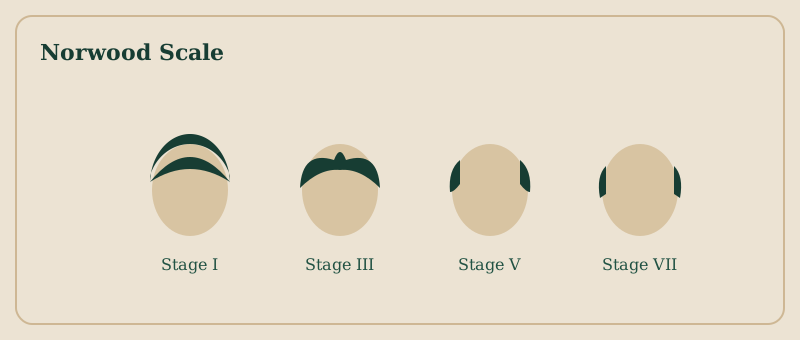
Norwood scale stages

The Norwood scale (sometimes called the Hamilton–Norwood scale) is the standard way doctors describe male pattern hair loss. It maps the typical progression into seven stages — a shared language that helps you and your doctor understand where you are now and plan sensibly for the future.

The seven stages

  • Stage 1: No significant hair loss or recession — essentially a full, adolescent hairline.
  • Stage 2: Slight recession at the temples and along the frontal hairline; often considered a mature hairline rather than true balding.
  • Stage 3: The first stage generally considered balding — noticeably deeper temple recession. Stage 3 Vertex describes early thinning at the crown as well.
  • Stage 4: More pronounced recession and crown thinning, with a band of hair still separating the two areas.
  • Stage 5: The band between the front and crown narrows as loss becomes more extensive.
  • Stage 6: The bridge of hair between front and crown largely disappears, leaving the two areas connected.
  • Stage 7: The most advanced stage — only a horseshoe band of hair remains around the sides and back, and it may itself be finer.

There’s also a “Type A” variant, where the hairline recedes from front to back fairly evenly without a distinct bald spot forming at the crown first.

Why your stage matters

Knowing your Norwood stage helps in three practical ways:

  • Choosing an approach: earlier stages may respond well to medical treatments to slow or manage loss, while more advanced stages are often where a transplant is considered.
  • Planning donor supply: more extensive loss needs more grafts, so matching demand to your finite donor area is key to a result that lasts.
  • Predicting the future: your stage — and how fast it’s changing — helps estimate where your hair loss may head, which is essential for designing a hairline that still looks natural years from now.

The scale is a guide, not a diagnosis

The Norwood scale describes patterns, but it doesn’t explain the cause or measure what’s happening at the follicle level. Objective assessment — such as trichoscopy to measure density and miniaturisation — adds the detail needed to give real advice. Not all hair loss is pattern hair loss, either, so a proper assessment is worthwhile.

Where do you sit? If you’re unsure of your stage or how quickly things are changing, an assessment can measure it objectively and set out your realistic options — including non-surgical ones. At 3D Hair Transplant, this is mapped with you before any treatment is recommended.

This article is general information only and is not medical advice. Hair loss has many causes; diagnosis and suitability for any treatment are determined at a consultation with an AHPRA-registered doctor.

Find out your options

Book a consultation with Dr Alex or Dr Ranadi for an objective assessment and honest advice.

Book a consultation Email us

← Back to Blog

This website is for general information only and does not constitute medical advice. Hair transplantation is a higher-risk non-surgical cosmetic procedure that carries risks; results vary between individuals. Suitability is determined at a consultation with an AHPRA-registered medical practitioner. Prepared with reference to AHPRA advertising guidelines.
✉ Email us Free photo assessment